
This post may contain affiliate links. For more information, see our Affiliate Disclosure Policy.
By Callie
The concept behind this love letter puff pastry is exactly what it sounds like: a puff pastry sheet folded into the shape of an envelope, filled with seared steak, tomato sauce, and melted mozzarella, sealed shut, decorated with pastry heart cutouts on top, and baked until deeply golden and flaky. The envelope shape makes it both visually deliberate (this is a “letter” with meaning) and practically useful (the sealed pastry holds the filling completely during baking, no leaking, no mess at the table). When you break it open at the table – pressing the fork down through the top crust and seeing the steak and melted cheese inside – the whole presentation earns its name.
I made these for the first time on a Valentine’s Day when I wanted something that felt more special than a standard weeknight dinner but less technically demanding than a full Beef Wellington. The love letter format threads that needle perfectly. The puff pastry does the heavy lifting aesthetically – store-bought puff pastry, handled correctly, produces a golden, flaky, dramatically beautiful crust without any pastry-making skill required. The steak is seared for 2 minutes per side before assembly to develop flavor and color before it finishes in the oven. The envelope fold and the heart cutouts are the presentation details that take 5 minutes and produce the occasion effect.
My husband’s reaction to the first batch: he opened the envelope at the table, saw the steak inside, and immediately said “this is the best Valentine’s dinner I’ve ever had.” He’s had many Valentine’s dinners with me, including some with considerably more effort than this one. I’m going to take the compliment at face value and not overthink the comparative context. The love letter puff pastry is the best Valentine’s dinner he’s ever had. Good to know.
For the full commitment beef-in-pastry experience that is the love letter’s more elaborate relative, the Classic Beef Wellington takes the same flaky-pastry-around-beef concept to its most dramatic conclusion – a full tenderloin wrapped in mushroom duxelles and pastry for a genuinely showstopping dinner that takes significantly more time and skill. The love letter is the approachable cousin; the Wellington is the occasion centerpiece for when you want to really go for it.
Why You Will Love This Love Letter Puff Pastry
- The envelope shape communicates occasion and intention in a way that a standard pastry-wrapped dish doesn’t. A folded pastry envelope with heart cutouts on top reads immediately as “this was made for you specifically” before the first bite. The shape is the message. No additional decoration is required – the envelope format and the heart accents do all the occasion work. This is the dish where the presentation is inseparable from the concept, and the concept is explicitly romantic.
- Store-bought puff pastry produces a genuinely stunning result without any pastry-making skill. All-butter frozen puff pastry (Pepperidge Farm, Dufour, or any brand that lists butter as a primary fat rather than vegetable shortening) bakes to a dramatically flaky, deeply golden, beautifully layered crust at 350 degrees F in 25 minutes. The visual impact of a properly baked puff pastry envelope is completely out of proportion to the effort of rolling it out and folding it. The pastry does the work; you assemble.
- The sear-then-bake two-stage cooking produces perfectly cooked steak inside the pastry. Searing the steak for 2 minutes per side at high heat before assembly creates the Maillard-browned exterior and locks surface flavor before the steak goes into the pastry. The 25 minutes in the oven at 350 degrees F finishes the interior gently and melts the mozzarella around the steak. This two-stage approach produces steak that is cooked through but not overcooked – the brief oven time after the sear finishes the interior to medium without pushing past. The specific cooking times depend on steak thickness; a 1-inch steak ends up around medium after the sear plus 25 oven minutes.
- The tomato sauce layer provides both flavor and moisture insurance for the steak during the oven phase. Without any moisture source in the pastry, a steak that is already browned from the sear can dry out during the additional oven time. The tomato sauce underneath the steak creates a slightly humid environment inside the sealed pastry that keeps the steak moist. It also adds flavor – the tomato sauce bakes into the pastry base slightly and provides the acidic counterpoint to the richness of the steak and mozzarella. Marinara, arrabiata, or any good tomato sauce works; skip the very thin, watery pasta sauces and use a thicker, more concentrated variety.
- The mini mozzarella balls plus shredded mozzarella combination produces the best cheese pull. Shredded mozzarella melts flat and coats the steak evenly; mini mozzarella balls (fresh bocconcini) provide concentrated pockets of molten, slightly elastic cheese that create the dramatic pull effect when the pastry is opened. Together they produce both even coverage and dramatic visual effect. The fresh mozzarella’s higher moisture content contributes to the steamy, melted, gooey interior; the shredded creates the binding layer.
- The cherry tomatoes add brightness and slight acidity that balances the richness of the steak and cheese. Inside a sealed pastry envelope with steak, mozzarella, and tomato sauce, the cherry tomatoes are the element that prevents the filling from being one-dimensionally rich. Their bright, slightly tart juice releases during baking and lifts the entire interior flavor. Halved cherry tomatoes – cut surface down onto the mozzarella – release their juice into the filling and collapse slightly during baking. Don’t skip them; they’re the balance the filling needs.
- The recipe makes 4 individual servings – each person opens their own envelope at the table, creating a simultaneous reveal moment. Four sealed pastry envelopes, four people at the table (or two, with leftovers), each person cutting into their own at the same moment. The simultaneous reveal – everyone discovering the steak inside their envelope at the same time – is a small but genuine theatrical moment at the dinner table. This is the specific quality that makes the love letter format more interesting than a single shared dish.
- The entire assembly can be done ahead and refrigerated, making this a dinner party-practical recipe. Assemble the love letter pastries completely up to 24 hours ahead, cover, and refrigerate on the baking sheet. Brush with egg wash and bake when guests arrive or when dinner service begins. The pastry benefits from the cold rest – colder pastry produces more dramatic puff in the oven because the cold butter layers expand more dramatically when they hit the heat. This is a dinner party recipe where all the impressive-looking work is done before guests arrive.
Love Letter Puff Pastry Ingredients
The Full Ingredient List (Makes 4 Love Letters)
- 2 steaks – ribeye or sirloin recommended; each steak will be split into 2 pastries after assembly (see notes)
- 1 sheet (about 9×9 inches when unrolled) frozen puff pastry, thawed according to package directions – all-butter variety preferred
- 1/2 cup (120ml) good-quality tomato sauce – thick, not thin pasta sauce
- 1/2 cup (55g) shredded mozzarella
- 8 fresh mini mozzarella balls (bocconcini)
- 8 cherry tomatoes, halved
- 1 egg, beaten with 1 tablespoon of water (for egg wash)
- Salt and pepper to taste
Ingredient Notes And Substitutions
Steak selection – ribeye vs sirloin vs other cuts: Ribeye is the most flavorful cut for this application because of its fat marbling – the fat renders during the sear and oven time, basting the meat from inside and keeping it moist. Sirloin produces a leaner result with slightly more beef-forward flavor and a firmer texture – excellent for people who prefer leaner steak. Strip steak (New York strip) is a good middle ground between the richness of ribeye and the leanness of sirloin. For this recipe, avoid very thin cuts (under 3/4 inch) which will overcook during the pastry baking time, and avoid very thick cuts (over 1.5 inches) which won’t fully cook through in the oven. A 1-inch steak is the ideal thickness for this recipe.
Puff pastry – all-butter is strongly preferred: All-butter puff pastry (Dufour is the most widely available premium brand; some store brands like Trader Joe’s also use butter) produces a richer, more flavorful, more dramatically flaky result than puff pastry made with vegetable shortening. The butter produces a deeper golden color and more pronounced layering during baking. Shortening-based pastry produces acceptable but noticeably less impressive results – lighter, paler, and less richly flavored. If all-butter isn’t available in your area, any frozen puff pastry is workable; all-butter is simply the best version. Thaw in the refrigerator overnight or at room temperature for 30-40 minutes – the pastry should be pliable but still cold when you work with it. Warm pastry doesn’t produce the same lift and flakiness as properly cold pastry.
The filling quantities and why they’re balanced: 1/2 cup of tomato sauce spread across 4 pastries is 2 tablespoons per pastry – thin enough to coat the base without making it wet. 1/2 cup of shredded mozzarella is about 2 tablespoons per pastry, which melts to cover the steak without overflowing the seal. 2 mini mozzarella balls and 2 halved cherry tomatoes per pastry is the right quantity to add dramatic visual effect and flavor enhancement without overfilling the envelope. Overfilling causes the most common assembly problem (seal failure) – restrain the filling quantities even when temptation to add more is strong.
Steak seasoning – simplicity is correct here: Salt and pepper only. The other flavors in the filling (tomato sauce, mozzarella, cherry tomatoes) provide complexity; the steak needs to taste like steak rather than a heavily seasoned piece of meat competing with the filling. Season the steaks generously with flaky salt and freshly ground pepper on both sides immediately before searing. No marinades, no additional spices. The steak’s own flavor, developed through the Maillard reaction during the sear, is what you want to taste.
Callie’s Kitchen Note: My husband’s “best Valentine’s dinner I’ve ever had” response to the love letter puff pastry has become a household reference point. Any subsequent Valentine’s dinner is measured against the love letter. When I suggested a different approach one year, he responded that the love letter was the standard he was accustomed to. The love letter puff pastry is now, through his own established precedent, the expected Valentine’s dinner format in our household. I find this both flattering and slightly limiting. The lesson: if you make something genuinely excellent for a specific occasion, be prepared for it to become the expected version of that occasion going forward.

How To Make Love Letter Puff Pastry
The Full Timeline
This is a Project Recipe with moderate active work and a clear structure. Active prep: approximately 30-35 minutes. Baking: 25 minutes. Total elapsed: about 1 hour. The assembly can be done the day before with baking the following day. The most time-intensive step is the careful puff pastry shaping and sealing – worth taking slowly to get the envelope shape clean and the seal secure.
1- Thaw And Prepare The Pastry
Thaw the frozen puff pastry according to package directions – typically 30-40 minutes at room temperature or overnight in the refrigerator (refrigerator thaw preferred). Work with cold-but-pliable pastry – if the sheet tears when you try to unfold it, it’s too cold and needs more thawing time; if it’s very soft and sticky, it’s too warm and needs a 10-minute return to the refrigerator. Lightly flour your work surface. Unroll or unfold the thawed pastry sheet and gently roll it with a rolling pin to an even thickness of about 3-4mm (just over 1/8 inch). Cut the sheet into 4 equal rectangles – these are the bases for each love letter.
Why Cold Pastry Is Critical For Lift And Flakiness
Puff pastry’s dramatic rise and layer separation during baking comes from the butter layers in the dough – when cold, solid butter meets oven heat, the water in the butter turns to steam and pushes the dough layers apart. If the butter is already soft before baking, it melts gradually rather than steaming explosively, and the pastry bakes to a flatter, denser, less dramatic result. This is why professional pastry kitchens keep puff pastry refrigerator-cold right until the moment it goes into the oven. Keep the pastry cold while you work, work quickly, and if the dough warms and softens during assembly, return it to the refrigerator for 10-15 minutes before baking.
2- Shape The Envelope
Working with one pastry rectangle at a time: fold the two corners of the top short edge down toward the center to create a triangular point, like the flap of an envelope. Gently crease the fold. Along the long sides of the rectangle, fold up a small border (about 1/2 inch) on both sides, creasing it firmly. This side border prevents the filling from spilling out horizontally during baking. The bottom half of the rectangle is the filling base; the top envelope flap will fold down to seal the pastry after filling.
3- Spread The Sauce And Sear The Steak
While the pastry envelopes are shaped and resting on a parchment-lined baking sheet (or in the refrigerator while you sear the steak): season the steaks generously with salt and pepper on both sides. Heat a cast iron or heavy-bottomed pan over high heat until very hot – a drop of water should evaporate immediately on contact. Add the steak with no oil (the steak’s own fat will render). Sear for exactly 2 minutes per side without moving – the full 2 minutes of undisturbed contact is what produces the deep brown Maillard crust. Remove from the pan to a cutting board. Allow to rest for 5 minutes while you spread the tomato sauce.
Spread 2 tablespoons of tomato sauce evenly over the filling base section of each pastry rectangle, staying within the folded side borders and away from the bottom third of the rectangle (which will become the bottom seal). Scatter 2 tablespoons of shredded mozzarella over the sauce.
Why The Steak Is Seared Before Going Into The Pastry
An un-seared steak placed directly into the pastry and baked produces a gray, steamed-looking, mild-flavored piece of beef rather than a brown, richly flavored one. The Maillard reaction – the chemical reaction between the amino acids and sugars on the surface of the meat at high temperature that produces brown color, roasted flavors, and hundreds of aromatic compounds – only happens at temperatures above approximately 280 degrees F (138 degrees C) on a dry surface. The surface of a steak in a sealed pastry envelope never reaches this temperature because of the moisture from the tomato sauce and cheese. Searing before assembly ensures the surface has already undergone the Maillard reaction and all its attendant flavors before the pastry seals around it.
4- Assemble And Seal
Slice each seared steak in half crosswise to produce pieces that fit within the filling base of one pastry rectangle. Place the steak over the mozzarella and tomato sauce. Add 2 mini mozzarella balls on top of and alongside the steak. Place 4 cherry tomato halves (cut side down) around and over the steak. The filling should look abundant but contained within the side borders – don’t let anything touch the edge of the unfold rectangle below the fold line.
Fold the bottom third of the pastry rectangle up over the filling, pressing the edges firmly against the filling (not compressing the filling itself, just pressing the pastry to the pastry at the edges where they overlap). Then fold the envelope flap down from the top, pressing its edges firmly against the bottom pastry section. Use the tines of a fork pressed along all sealed edges to crimp firmly – this creates both a decorative pattern and a mechanical seal that prevents the pastry from opening during baking. Pay particular attention to the bottom point of the envelope flap and the two bottom corners where the side borders meet the base.
5- Decorate And Bake
From the pastry scraps (or a separate small piece of reserved pastry): use a small heart-shaped cookie cutter or a sharp knife to cut 2-3 small pastry hearts per envelope. Place them on the top of each sealed envelope, pressing very gently to adhere. Beat the egg with 1 tablespoon of water. Brush the egg wash over the entire top surface of each pastry envelope, including the heart decorations, ensuring complete coverage – the egg wash is what produces the deep golden-brown, slightly shiny finished surface.
Bake at 350 degrees F (175 degrees C) for 25 minutes until deeply golden-brown across the entire top surface with clearly visible flaky layering at the cut edges. The pastry should look fully baked rather than pale golden – pale golden indicates underbaking and produces a doughy interior layer nearest the filling. Serve immediately.
Callie’s Kitchen Note: The sealing step is the most important assembly detail and the one most likely to be rushed. A properly sealed love letter pastry holds all its filling through the 25-minute bake and delivers a clean, dramatic reveal at the table. An under-sealed one allows the tomato sauce and cheese to bubble through the seal, creating a messy, less dramatic presentation and a potentially soggy pastry base. The fork crimp around all edges is not decorative – it’s structural. Take the full minute per pastry to crimp firmly all the way around, overlapping the crimp impressions slightly so no section of the seal is left without a firm mechanical bond. The result of good sealing: a pastry that puffs dramatically all over rather than deflating where the filling leaked. Worth the extra care.
Common Mistakes To Avoid
Working With Warm, Soft Pastry
Warm puff pastry sticks to the work surface, tears when handled, and produces a flat, dense result in the oven rather than a dramatic puff. If at any point the pastry becomes noticeably soft and sticky while you’re working: return it to the refrigerator for 10-15 minutes. Cold pastry is much easier to shape, fold, and seal, and produces a dramatically better finished result.
Overfilling The Pastry
The most common cause of seal failure. More filling creates more pressure inside the sealed pastry during baking as the filling heats and the liquids expand. This internal pressure pushes through any weak point in the seal. Stick to the specified quantities – 2 tablespoons of sauce, 2 tablespoons of shredded cheese, 2 mini mozzarella balls, 4 cherry tomato halves per pastry. The filling may look modest during assembly but expands and becomes more cohesive during baking.
Skipping The Pre-Sear On The Steak
An un-seared steak inside a pastry envelope will be gray, slightly steamed-looking, and lacking the deep flavor complexity of Maillard-browned meat. The 2-minute sear per side is the step that makes the steak taste like good steak inside the pastry rather than soft meat. It takes 6 minutes total including the rest. Don’t skip it.
Not Sealing The Edges Thoroughly
Already covered in the Kitchen Note but worth the separate entry: a fork crimp applied lightly or only to part of the perimeter leaves escape routes for the filling. Crimp firmly, all the way around, with overlapping impressions. The mechanical interlocking of the fork tines is what holds the seal against baking expansion pressure. A light touch produces a decorative pattern but not a reliable seal.
Under-Baking The Pastry
Puff pastry that looks pale golden rather than deep golden-brown may still have a doughy, partially raw layer closest to the filling where the steam from the filling has prevented full baking. The deep golden-brown surface color indicates the full pastry depth has reached baking temperature and cooked through. At 350 degrees F in a calibrated oven, 25 minutes produces a deep golden result. If your oven runs cool: add 5 minutes and check the color before removing.
Callie’s Kitchen Note: Emily’s reaction to the love letter puff pastry the first time I made them for a Valentine’s family dinner was to ask if she could cut hers open “in private” – in the kitchen rather than at the table. I said no, the point is the reveal at the table together. She was skeptical. She cut hers open at the table along with everyone else, saw the steak and melted mozzarella, and immediately offered to make these “every Valentine’s Day from now on.” She has made this offer every year since without following through on the execution, but the enthusiasm is genuine and the annual offer is touching in its consistency. The reveal moment at the table is genuinely surprising and delightful even on the second and third encounter – it doesn’t stop being a good reveal because you know what’s inside.
Storage And Reheating
Refrigerator: Store leftover love letter puff pastries in an airtight container in the refrigerator for up to 3 days. The pastry softens in storage as moisture from the steak and sauce filling redistributes through the layers. Reheating restores the crispiness effectively.
Oven reheating (best method): Place on a baking sheet at 350 degrees F for 10-12 minutes until warmed through and the pastry has re-crisped. The oven heat evaporates the surface moisture that accumulated during storage and restores the flaky, golden texture. This is significantly better than microwave reheating for any puff pastry dish.
Air fryer reheating: 375 degrees F for 5-7 minutes. Excellent at restoring the crispy puff pastry texture from the outside in – comparable to the oven method in less time. Preferred if speed is a priority.
Freezer (assembled, unbaked): Assembled but unbaked love letter pastries freeze well for up to 1 month. Freeze on a baking sheet until solid, then wrap individually and transfer to a freezer bag. Bake directly from frozen at 350 degrees F, adding 10-15 minutes to the standard 25-minute bake time. Brush with egg wash immediately before the oven, not before freezing (the egg wash doesn’t freeze and thaw as well as the pastry does).
Make-ahead (assembled, refrigerated): Assemble completely up to 24 hours ahead. Store covered in the refrigerator. Apply egg wash and bake as directed on the day – add 3-5 minutes to the bake time from the cold starting temperature. The cold rest actually helps the pastry puff more dramatically.
Love Letter Puff Pastry Variations
Chicken And Brie Love Letters
Replace the steak with thin-pounded chicken breast (1/2-inch thick cutlets), seasoned with salt, pepper, and a pinch of thyme, seared 3 minutes per side. Replace the tomato sauce with 2 tablespoons of pesto per pastry. Replace the mozzarella with thinly sliced brie (rind removed) – brie melts more fluidly than mozzarella and produces a different, more sophisticated cheese experience. Replace the cherry tomatoes with halved black grapes or sliced apple for a fruit-and-brie combination that is specifically excellent against the chicken and pesto. Bake as directed. The chicken-brie version is less intensely meaty than the steak version and works well as the dinner party option for mixed audiences.
Mushroom And Goat Cheese (Vegetarian)
Replace the steak with large portobello mushroom caps, seasoned with salt, pepper, olive oil, and a splash of balsamic vinegar, seared 3 minutes per side. Replace the tomato sauce with pesto or roasted red pepper puree. Replace the mozzarella with crumbled goat cheese and the mini mozzarella balls with halved cherry tomatoes arranged cut-side-up. Add a scatter of spinach leaves over the mushroom before sealing. Bake as directed. The vegetarian love letter is a genuinely satisfying alternative that holds the envelope shape as well as the steak version – the portobello mushroom’s density and the goat cheese’s richness make it feel substantial rather than like a reduced version of the original.
Salmon And Cream Cheese Love Letters
Replace the steak with salmon fillets (1-inch thick, skin removed), seasoned with salt, pepper, and dill, seared 2 minutes per side (the center will still be slightly underdone – it finishes in the oven). Replace the tomato sauce with 2 tablespoons of cream cheese thinned slightly with a teaspoon of lemon juice. Replace the mozzarella with crumbled feta or omit entirely. Add 4 slices of cucumber (seeded) and a few capers. Bake as directed but reduce baking time to 18-20 minutes – salmon finishes faster than steak. The salmon version has a completely different flavor profile – bright, fresh, creamy, and specifically appropriate for anyone who doesn’t eat red meat.
Pizza Love Letters
Replace the steak entirely and focus purely on the pizza-adjacent filling: spread tomato sauce as directed, add pepperoni slices or Italian sausage (cooked and crumbled), use only mozzarella (no mini balls needed), add sliced olives and bell pepper. Fold and seal as directed. Bake as directed. The pizza love letter is the children’s version of this recipe – all the familiar pizza flavors in a dramatic pastry envelope. Emily’s preferred Valentine’s version when the steak feels too sophisticated for what she’s in the mood for. Works exactly as well as the steak version and is faster because there’s no steak searing step.
Caramelized Onion And Blue Cheese Love Letters
Slowly caramelize 2 large sliced onions in butter with a pinch of sugar and salt for 30-40 minutes until deep golden-brown and jammy. Replace the tomato sauce with a base of caramelized onion spread (2 tablespoons per pastry). Replace all the mozzarella with crumbled blue cheese (use sparingly – blue cheese is intensely flavored and 1 tablespoon per pastry is plenty). Replace the cherry tomatoes with walnuts. The steak can stay or be replaced by the caramelized onion as the primary filling for a vegetarian version. The blue cheese and caramelized onion combination against the flaky pastry is a sophisticated, complex flavor profile that is specifically excellent for adults who appreciate more challenging flavors.
Dark Chocolate And Berry Dessert Love Letters
Skip the steak entirely and make a dessert version. Spread 2 tablespoons of chocolate hazelnut spread over the pastry base. Add a small handful of fresh raspberries and blueberries. Scatter 1 tablespoon of chocolate chips. Fold, seal, and bake as directed but at 375 degrees F for 20 minutes. Dust with powdered sugar immediately after baking. The dessert love letter with chocolate and berries provides the same dramatic sealed-envelope presentation in a sweet context – a genuinely impressive dessert that takes 10 minutes of assembly and uses the same puff pastry technique. Serve with vanilla ice cream or whipped cream.
Serving Suggestions
The Valentine’s Day Dinner At Home
One love letter pastry per person, plated on a white plate with a small undressed arugula salad alongside (the peppery arugula is the lightest, most appropriate green against the rich pastry filling), a drizzle of good balsamic glaze across both the pastry and the arugula, and a small scattering of fresh basil leaves. White plate, dark green arugula, deep golden pastry, red balsamic drizzle – the color combination is deliberately beautiful. A candle on the table. Glasses of red wine poured before sitting. The simultaneous opening of the pastry envelopes at the table is the moment the dinner has been building toward.
For A Small Dinner Party
The love letter format works for 2, 4, or 6 servings from a doubled or tripled batch. For more than 4 people: assemble the pastries in advance and bake all at once, timing to serve hot from the oven. A large baking sheet can accommodate 4 pastries simultaneously; two sheets in the oven simultaneously (with rotation halfway through) accommodates 8. For 6 guests: bake 6 pastries on two staggered sheets and serve in two rounds, 3 minutes apart – the slight temperature difference between the first and second batch is barely perceptible to diners and much easier than trying to bake 6 at once.
Main Course Accompaniments
- Arugula salad with lemon vinaigrette – the bitterness of the arugula and the acid of the lemon provide the most effective contrast to the rich steak and pastry
- Roasted asparagus with flaky salt – the vegetable side that takes 12 minutes and can bake in the same oven as the pastry (on a separate sheet, on the lower rack)
- Simple green salad with Steak Fettuccine Alfredo as a first course for a full steak-themed Valentine’s dinner – but two rich courses requires committed appetites
- Roasted cherry tomatoes (simply halved, olive oiled, and roasted alongside the pastries for the last 15 minutes) as an additional side that echoes the cherry tomatoes inside the pastry

Love Letter Puff Pastry FAQ
A soggy pastry base happens when too much liquid from the filling seeps down into the bottom pastry layer during baking. Three preventions. First: don’t overfill with sauce – 2 tablespoons per pastry is the right quantity. Second: don’t skip the side border fold – folding up the edges of the pastry base creates a slight dam that keeps the filling contained vertically. Third: bake on a hot baking sheet (preheat the baking sheet in the oven for 5 minutes before placing the pastries on it) – the pre-heated sheet immediately sets the bottom pastry layer before the filling liquid can penetrate. A hot baking sheet is the professional technique for producing a crispy puff pastry bottom.
Yes – any steak that is approximately 1 inch thick and tender enough to eat in a pastry format works. Ribeye and sirloin are the best choices. Flank steak or skirt steak can work but are chewier and more grain-forward – slice them against the grain before placing in the pastry. Filet mignon produces the most tender result of any cut but is expensive for this application where the steak is surrounded by other ingredients. Avoid very tough cuts like chuck or brisket – the brief oven time isn’t sufficient to tenderize them and the result will be chewy and unsatisfying.
The steak is pre-seared for 2 minutes per side before assembly, which brings it to rare-to-medium-rare throughout depending on thickness. An additional 25 minutes in the oven at 350 degrees F finishes most 1-inch steaks to medium (140 degrees F internal temperature). For steak thickness variations: a 3/4-inch steak may reach medium-well in 25 minutes (add the steak later in the oven time if you prefer medium); a 1.25-inch steak may be slightly rare at 25 minutes (extend the oven time by 5 minutes). If using a thermometer: probe through the pastry crust gently at the thickest point of the steak near the end of baking – the pastry hole closes back around the probe and seals.
Yes – the hearts are decorative and optional. The envelope shape itself communicates the theme without them. If you’re making these outside of Valentine’s Day context (for an anniversary, birthday, or simply a special weeknight dinner), omit the hearts and the pastry is simply a beautifully shaped pastry envelope. The heart cutouts require an extra 5 minutes and a small cookie cutter; they are worth the effort for Valentine’s Day specifically but are not structurally necessary.
Yes – making both the steak version and the portobello mushroom version simultaneously is completely feasible. Both use the same pastry technique and the same oven temperature and time. Distinguish the two visually: use a different topping arrangement on the mushroom versions (one heart cutout vs two, for example, or place a small basil leaf on the vegetarian versions before serving). Communicate clearly at the table which is which before anyone cuts in.
Insufficient puff has three common causes. First: the pastry was too warm when it went into the oven – return the assembled pastries to the refrigerator for 15 minutes before baking if they softened during assembly. Second: the oven temperature was too low – verify with an oven thermometer; many home ovens run 25-50 degrees cooler than the dial indicates. Third: vegetable shortening-based puff pastry rather than all-butter – shortening-based pastry produces less dramatic puff than butter-based because the water content in butter (which turns to steam and drives the puffing) is absent in pure shortening. Try all-butter puff pastry for the most dramatic result.
Recipes You May Like
If this love letter puff pastry has you in the spirit of impressive beef-and-pastry main dishes for romantic occasions, here are three more from the blog in the same category.
Classic Beef Wellington – The love letter’s more elaborate, more dramatic relative in the beef-in-pastry category. Where the love letter is four individual pastry envelopes filled with steak and cheese, the Beef Wellington is a whole beef tenderloin wrapped in mushroom duxelles and puff pastry for a single centerpiece dish that serves 6-8 people. If the love letter is the approachable date-night version of beef-in-pastry, the Wellington is the full dinner party showstopper. Both are worth mastering for different occasions; the love letter teaches the pastry techniques that make the Wellington’s more demanding assembly feel more approachable.
Steak Fettuccine Alfredo – The creamy pasta companion for a Valentine’s Day steak dinner where the love letter provides the dramatic main and the fettuccine Alfredo provides the rich, indulgent pasta course. Both feature quality beef; both are occasion-appropriate; both are genuinely impressive from a home kitchen. Serving both in the same Valentine’s dinner is ambitious but satisfying for anyone who wants to go all out on the occasion.
Ham And Cheese Puff Pastry Hearts – The lighter, hand-held companion in the savory puff pastry category. Where the love letter is a full dinner-sized pastry envelope with steak, the puff pastry hearts are small, individual savory pastries sized for appetizers or party bites. Both use puff pastry in a savory filling application; the hearts are heart-shaped, the love letters are envelope-shaped. Together they cover different occasions and meal courses while sharing the same pastry-and-savory-filling concept.
Conclusion
This love letter puff pastry is the Valentine’s dinner that set a household standard I didn’t anticipate setting. “Best Valentine’s dinner I’ve ever had” is a high bar that is now expected to be met annually. The love letter puff pastry meets it every time, which is more than can be said for most ambitious dinner attempts.
The cold pastry makes the puff. The steak sear makes the flavor. The thorough fork crimp makes the seal. The simultaneous opening at the table makes the moment. Those four things, done correctly, produce the dinner that earns the response this recipe earned the first time.
Emily’s annual offer to help make these and annual non-execution of that offer is a household tradition I’ve accepted. The offer is always touching. The execution remains my responsibility. Tell me in the comments which version you made (steak, chicken, mushroom, or pizza for the children) and whether you attempted the dessert chocolate-and-berry version for a second course. Save this to Pinterest for your next Valentine’s Day or romantic occasion dinner – and happy cooking!
Happy cooking! – Callie
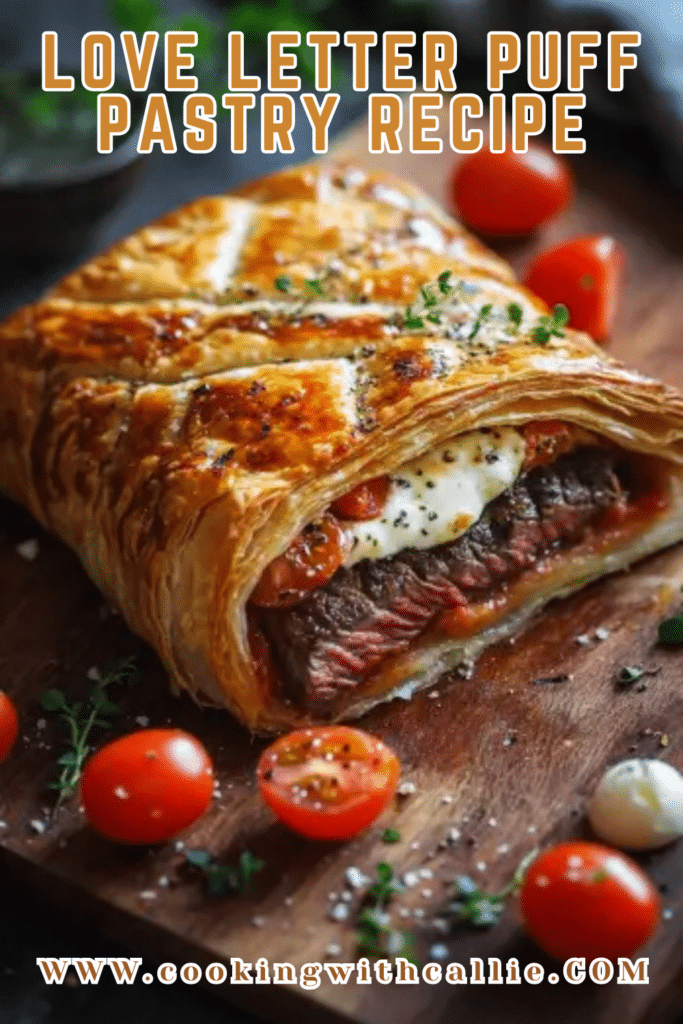

Love Letter Puff Pastry Recipe

This Love Letter Puff Pastry recipe is a delightful combination of flaky, golden pastry wrapped around tender steak, melted mozzarella, and rich tomato sauce. With heart-shaped accents and a savory filling, it’s the perfect dish for romantic dinners, Valentine’s Day, or a cozy meal at home. Simple to make and bursting with flavor, this recipe is sure to impress your loved ones.
- Prep Time: 15 minutes
- Cook Time: 25 minutes
- Total Time: 40 minutes
- Yield: 4 servings 1x
- Category: Main Course
- Method: Baking
- Cuisine: European
- Diet: Low Lactose
Ingredients
- 2 steaks (ribeye or sirloin)
- 1 sheet puff pastry
- ½ cup tomato sauce
- ½ cup shredded mozzarella cheese
- 8 mini mozzarella balls
- 8 cherry tomatoes, halved
- 1 egg (for egg wash)
- Salt and pepper to taste
Instructions
- Preheat your oven to 350°F (175°C).
- Roll out the puff pastry and cut it into rectangles. Fold the top corners to form an envelope shape, and fold up the long sides to create a border. Spread the tomato sauce evenly inside the pastry.
- Season the steaks with salt and pepper. Sear them in a hot pan for 2 minutes per side until browned. Place the seared steaks over the tomato sauce.
- Sprinkle shredded mozzarella on top, followed by mini mozzarella balls.
- Fold the bottom half of the dough over the steak, then fold the top down to complete the envelope shape. Press the edges with a fork to seal.
- Cut small heart shapes from the remaining dough and place them on top of the pastry.
- Transfer to a baking sheet lined with parchment paper. Brush with beaten egg for a golden finish.
- Bake for 25 minutes or until the pastry is golden brown and crispy.
- Serve warm and enjoy with your favorite sides.


Notes
- For a crispier texture, chill the assembled pastry for 10 minutes before baking.
- Substitute chicken or portobello mushrooms for a different filling option.
- Pair with a fresh salad or roasted vegetables for a complete meal.
Nutrition
- Serving Size: 1 puff pastry
- Calories: 520 kcal
- Sugar: 4g
- Sodium: 580mg
- Fat: 32g
- Saturated Fat: 15g
- Unsaturated Fat: 14g
- Trans Fat: 0g
- Carbohydrates: 32g
- Fiber: 2g
- Protein: 28g
- Cholesterol: 110mg