This post may contain affiliate links. For more information, see our Affiliate Disclosure Policy.
By Callie
This vegan Brussels sprouts salad came together from leftover broccoli crowns and a bag of pre-shredded Brussels sprouts on an evening when I was looking for something quick, nourishing, and more interesting than the standard steamed vegetable. The tahini dressing is specifically what makes this more than a vegetable side: tahini (sesame paste) as the dressing base rather than oil-and-vinegar produces a dressing that is simultaneously creamy, nutty, and bright from the lemon and lime juice. Tamari is the ingredient that most people would not think to add to a green salad dressing, and it is specifically what prevents the tahini from tasting like plain sesame paste – the tamari’s salt and umami depth provide the savory note that makes the dressing complex rather than just creamy and tart.
Raw shredded Brussels sprouts are the textural base – the pre-shredded variety available at most grocery stores is specifically the time-saving choice, but whole Brussels sprouts can be shredded in 5 minutes using the shredding disk of a food processor or a mandoline. The shredded sprout has a specifically different eating experience from the roasted or steamed whole Brussels sprout – it’s crisp, mildly bitter, and specifically nutty in its raw state, and it holds its crunch even after 2-3 days in the refrigerator with dressing applied. This holding power is specifically why this salad makes it into the meal prep rotation rather than being strictly a same-day preparation.
The clementine segments are the citrus counterpoint that the bitter Brussels sprout specifically needs – the sweet, juicy, easy-to-peel clementine segments provide a brightness and sweetness that makes the earthy cruciferous vegetables specifically more appetizing. I first made this on a whim and added it to the meal prep rotation immediately because the first bite was so specifically right. For the raw broccoli companion that uses the same raw-cruciferous-vegetable-as-base approach with a lemon-Dijon dressing instead of tahini, the Broccoli Crunch Salad With Apples And Almonds is the lighter, apple-fruit companion in the same vegan-and-gluten-free raw cruciferous vegetable salad category.
Speed Hacks – Brussels Sprouts Tahini Salad In 20 Minutes:
- Buy pre-shredded Brussels sprouts from the produce section – this saves 10+ minutes of manual shredding or food processor setup; the pre-shredded variety is exactly correct for this application
- Microwave-steam the broccoli instead of stovetop steaming – place florets in a microwave-safe bowl with 2 tablespoons of water, cover tightly with plastic wrap or a plate, and microwave on high for 2-3 minutes; check at 2 minutes and continue in 30-second increments until just fork-tender; saves the time of heating a steamer and waiting for water to boil
- Make the dressing the night before and refrigerate in a small jar – it keeps for 5 days and the flavors meld further overnight; day-of prep is just steaming broccoli, segmenting clementines, and tossing
- Stir the tahini before measuring – tahini from the refrigerator or a jar that hasn’t been used recently has separated oil on top; stir before measuring and the dressing comes together in 30 seconds of whisking
- Use a food processor with the shredding disk if shredding your own Brussels sprouts – place a stack of trimmed sprouts in the feed tube and the disk shreds 2 cups in approximately 60 seconds
Why You Will Love This Vegan Brussels Sprouts Salad
- Raw shredded Brussels sprouts hold their crunch for 2-3 days in the refrigerator even when dressed, making this specifically more meal-prep-appropriate than most dressed green salads. Leafy greens (arugula, spinach, romaine) wilt and become waterlogged within hours of being dressed. Raw shredded Brussels sprouts: their cell walls are specifically more rigid and their water content is lower than leafy greens, so they maintain their crunch for significantly longer after dressing. The slight softening that occurs during 24 hours of refrigerator storage actually improves the eating experience for many people – the raw edge of fresh-shredded Brussels sprouts mellows to a more specifically pleasant, slightly tender-crisp texture after a day in the refrigerator with the dressing’s acid softening the outermost layer slightly. This is specifically the salad to make on Sunday for 3 days of lunches.
- Tahini as the dressing base rather than oil-and-vinegar produces a creamy, nutty, protein-rich dressing that is specifically more satisfying than a standard vinaigrette for a cruciferous vegetable salad. Tahini is ground sesame paste, approximately 50% fat and 25% protein by weight. As a dressing base: it provides creaminess from its natural fat, protein that contributes to satiety, and a specifically nutty, slightly bitter sesame character that is specifically complementary to the similarly slightly bitter raw Brussels sprout. The combination of tahini (bitter-nutty) with Brussels sprouts (bitter-earthy) is not competing bitterness – it’s complementary bitterness, two ingredients whose specific flavor registers work in the same direction, both tamed and brightened by the citrus’s acid and the maple’s sweetness.
- Tamari in the dressing is specifically the ingredient that provides the umami depth that makes the tahini dressing taste complex rather than just creamy and tart. Tahini plus citrus plus maple: creamy, tangy, sweet – pleasant but one-dimensional. Tahini plus citrus plus maple plus tamari: the tamari’s fermented soy protein provides glutamate (the same amino acid responsible for the umami taste in parmesan, soy sauce, and miso), which signals the brain as “savory” and “complete” in a way that fat and acid alone don’t. The tamari also provides the dressing’s primary salt, making it taste specifically seasoned rather than requiring additional salt. For a gluten-free dressing: tamari (made without wheat) is specifically correct over regular soy sauce, which contains wheat.
- The clementine segments provide the sweet, juicy, citrus brightness that makes bitter raw cruciferous vegetables specifically more appealing – especially for people who find Brussels sprouts challenging in other preparations. Raw Brussels sprouts’ bitterness comes from glucosinolates (the same compounds responsible for broccoli and kale’s distinctive flavors). Sweetness from the clementine specifically moderates the bitter perception in the same way sweetness generally reduces bitter perception – the sweet signal competes with and partially masks the bitter signal at the taste receptor level. Someone who finds roasted Brussels sprouts acceptable but raw Brussels sprouts too bitter: the clementine’s sweetness provides the specific balance that makes the raw version palatable. This is specifically why the citrus is not decoration in this salad but a specifically functional ingredient.
- Turmeric in the dressing adds a warm, slightly earthy note and a vivid yellow color that tints the creamy tahini dressing golden, making the final salad’s visual more specifically striking. Turmeric’s primary flavor compound (curcumin) is mildly bitter and specifically earthy – at 1/2 teaspoon in the dressing, it adds background warmth without specifically tasting of turmeric. The visual contribution (the golden-yellow tint in the cream) is as specifically important as the flavor contribution in a salad where the visual impact is part of what earns it a place at a holiday or dinner party table. Turmeric’s anti-inflammatory properties are well-documented but specifically not the primary reason it’s in this recipe; the flavor and color are the specific reasons.
Vegan Brussels Sprouts Salad Ingredients
Salad (Serves 4-6)
- 4 to 5 cups (approximately 1 large head or 280g) fresh broccoli crowns, cut into small bite-sized florets
- 2 cups (approximately 200g) shredded Brussels sprouts (pre-shredded or shredded fresh from approximately 10-12 medium sprouts)
- 3 clementines, peeled and segmented (or 2 small navel oranges, segmented)
Tahini-Citrus Dressing
- Juice of 1 lemon (approximately 3 tablespoons)
- Juice of 2 limes (approximately 3-4 tablespoons)
- 3 tablespoons tahini, well-stirred before measuring
- 2 tablespoons tamari (or soy sauce, or coconut aminos for soy-free)
- 1 tablespoon pure maple syrup
- 1/2 teaspoon ground turmeric
- 3 tablespoons extra-virgin olive oil (or water for an oil-free version)
- Water, 1-3 tablespoons as needed, to thin to pourable consistency
Ingredient Notes
Tahini quality and preparation: Natural tahini (made from only ground sesame seeds, no additives) separates during storage into sesame oil on top and denser paste below. Before measuring: stir vigorously with a butter knife in the jar until uniform. Unstirred tahini produces a dressing that is either too oily (if you measure from the top) or too thick and dry (if you measure from the bottom). Once stirred, tahini produces a consistently creamy, uniform dressing. Store stirred tahini at room temperature (re-separated tahini at room temperature is easier to re-stir than refrigerator-cold separated tahini).
Shredding your own Brussels sprouts: Trim the stem end of each sprout (the brown, dry bottom), remove any loose or yellowed outer leaves, and cut in half lengthwise. Using the shredding disk of a food processor: process halved sprouts through the feed tube for the most uniform result. Using a mandoline: slice each halved sprout on the mandoline set to approximately 1/8-inch thickness. Using a knife: slice each half into thin strips. All three methods produce good shredded Brussels sprouts; the food processor is fastest for a large quantity.
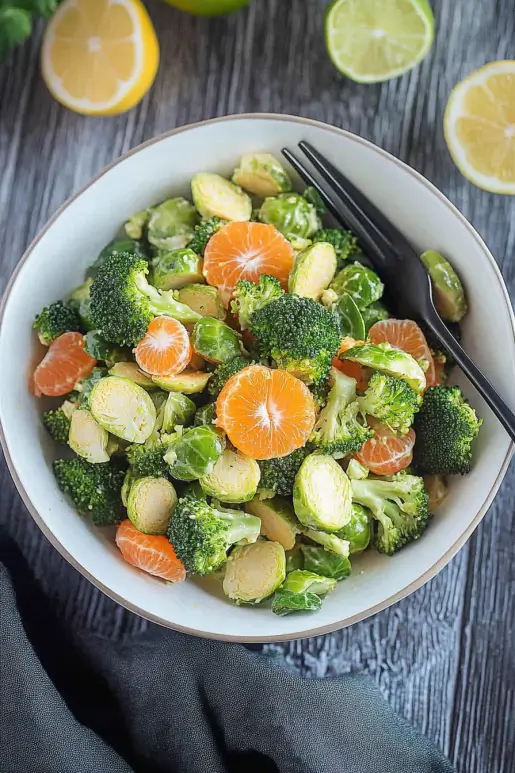
Broccoli: steamed for this recipe, not raw. Unlike the broccoli crunch salad (which uses raw broccoli specifically for its raw crunch), this recipe calls for lightly steamed broccoli – 5-6 minutes until bright green and just fork-tender. The steamed broccoli provides a softer, less assertively raw texture that complements the raw shredded Brussels sprouts’ crunch. The visual of bright green steamed broccoli against the paler green shredded Brussels sprouts and the orange clementine segments is specifically part of the salad’s appeal. Oversteamed broccoli (mushy, gray-green) would be both texturally and visually wrong for this application.
Callie’s Kitchen Note: The “tahini separates in the jar” phenomenon is the most frequent tahini-related kitchen problem I encounter, and the solution is straightforward: always stir before measuring, always. I keep a dedicated butter knife in the drawer specifically for stirring tahini jars and peanut butter jars – a regular spoon doesn’t reach the bottom of the jar effectively. The knife, pushed to the jar’s bottom and stirred in circles, re-incorporates the oil and paste uniformly in approximately 30 seconds. Once stirred: the dressing whisks together in another 30 seconds and is immediately ready. The separation is not spoilage; it’s specifically natural for any single-ingredient nut or seed paste without emulsifiers. Stir before every use.

How To Make Vegan Brussels Sprouts Salad
1- Steam The Broccoli
Fill a medium saucepan with 1-2 inches of water and bring to a boil. Place the broccoli florets in a steamer basket above the water (or use a microwave method: 2 tablespoons of water in a covered bowl, 2-3 minutes on high). Steam for 5-6 minutes until the broccoli is bright green and just fork-tender – a fork should pierce the stem of a floret with slight resistance. Immediately remove from heat. Do not leave in the steamer basket after reaching this stage – the residual steam continues cooking the broccoli and will push it from just-tender to mushy within 2-3 minutes.
Transfer the steamed broccoli to a plate or cutting board and allow to cool to room temperature before adding to the salad. Warm broccoli in contact with the raw Brussels sprouts slightly wilts the raw sprouts’ exterior cells; warm broccoli in contact with the tahini dressing causes the dressing to thin slightly as it absorbs the heat. Room temperature broccoli is specifically correct before assembly.
Why Bright Green Is The Visual Indicator For Correctly Cooked Broccoli
When broccoli is placed in steam: the heat initially drives off the small air pockets between the broccoli’s cells, allowing the cells’ bright green chlorophyll to become more visible against a now-clear rather than air-filled intercellular space. This produces the specifically vivid bright green that broccoli develops in the first few minutes of steaming. As steaming continues: the heat breaks down the chlorophyll’s porphyrin ring, changing its color from bright green to gray-green (the color of overcooked broccoli). Bright green = correctly cooked; gray-green = overcooked. The color change is the specific visual indicator that is more reliable than a timer because it reflects the actual chemical state of the broccoli rather than an assumed elapsed time.
2- Make The Tahini Dressing
In a small bowl: combine the lemon juice, lime juice, well-stirred tahini, tamari, maple syrup, turmeric, and olive oil. Whisk together until uniform and smooth. The tahini will initially seize when it contacts the citrus juice (the same phenomenon as tahini clumping when water is added before oil) – continue whisking vigorously and it will smooth out within 30-60 seconds of consistent whisking. Add water 1 tablespoon at a time until the dressing reaches a pourable consistency that coats the back of a spoon but flows from it when tilted.
Taste the dressing: it should be simultaneously nutty (from the tahini), tangy (from the citrus), savory (from the tamari), and slightly sweet (from the maple). These four notes should be in rough balance. If too thick: add water. If too tart: add a few more drops of maple syrup. If bland: add a splash more tamari. If too bitter: the tahini may be an older or lower-quality batch; a small additional teaspoon of maple syrup balances this.
Callie’s Kitchen Note: The tahini-seizes-on-contact-with-citrus-juice phenomenon is specifically the one that made me think something had gone wrong the first time I made a tahini dressing. You whisk the tahini with the lemon juice and it immediately thickens into a stiff, grainy-looking paste rather than smoothing out. This is a natural chemistry reaction: the tahini’s sesame proteins denature in the acid’s presence before the oil has dispersed. The solution: whisk vigorously and continuously for 30-60 seconds, and add the olive oil gradually while whisking – the oil’s presence as you whisk helps re-disperse the seized proteins into a smooth emulsion. If the dressing is still too thick after adding the oil: add water one tablespoon at a time while whisking, and the dressing will smooth out progressively. This is specifically not the dressing failing; it’s the expected chemistry of tahini with acid, and it resolves with continued whisking.
3- Assemble And Dress
In a large mixing bowl: combine the cooled steamed broccoli, shredded Brussels sprouts, and clementine segments. Toss gently to distribute the components. Pour approximately 2/3 of the dressing over the salad and toss to coat. Taste and add more dressing if needed – the salad should be well-coated but not swimming in dressing. The Brussels sprouts and broccoli absorb the dressing progressively during storage, so slightly more dressing at assembly than seems necessary is appropriate for a make-ahead version.
Serve immediately or refrigerate. For immediate serving: the raw Brussels sprouts are at their most crisp and the citrus is at its most vivid. For a make-ahead version stored overnight: the Brussels sprouts slightly tenderize from the dressing’s acid, the flavors integrate more fully, and the dressing’s golden color has permeated the salad more thoroughly. Both the just-made and overnight versions are specifically good; the character of the two versions is different enough that some people specifically prefer one direction over the other.
Callie’s Kitchen Note: The tamari-in-a-salad-dressing surprise is specifically what I want to mention because it doesn’t seem obvious until you taste the dressing without it and then with it. Without tamari: the tahini dressing is creamy, tangy, and mildly sweet – pleasant but somehow incomplete in a way that’s hard to articulate. With tamari: the same dressing is suddenly complete, specifically savory, and has a depth that makes you want to keep tasting it. Tamari is doing the umami work here – providing the glutamate signal that tells the brain “this is a complete and satisfying seasoning” rather than “this is something pleasant that could use more.” For the same reason that parmesan makes pasta taste complete and miso makes soup taste complete: tamari makes this dressing taste complete. It’s the ingredient that most surprises people when they read the recipe, and the one they specifically thank me for including when they make it.
Common Mistakes To Avoid
Overcooking The Broccoli
The most impactful mistake. Overcooked broccoli loses its color (from bright green to gray-green), loses its texture (from crisp-tender to mushy), and becomes waterlogged – releasing this water into the salad and diluting the dressing. Steam only to the bright-green, just-fork-tender stage. Remove from heat at that point and transfer to a plate immediately to stop the cooking.
Not Stirring The Tahini Before Measuring
Unstirred tahini measures inconsistently. The top oil-heavy layer produces a too-oily dressing; the bottom paste-heavy layer produces a too-thick dressing. 30 seconds of stirring before measuring produces a consistent, uniform tahini paste that makes the dressing correctly every time.
Panicking When The Dressing Seizes On Contact With Citrus
This is expected and reversible. Whisk vigorously for 30-60 seconds and add the olive oil gradually while whisking. The dressing will smooth out. Do not add all the water at once trying to fix a seized dressing – add water one tablespoon at a time while whisking continuously until smooth and pourable.
Skipping The Clementines
The clementine segments are not optional garnish – they are specifically functional, providing the sweetness that moderates the Brussels sprout’s bitterness and the juice that adds brightness. A Brussels sprout and broccoli salad without the citrus is specifically more bitter and less specifically interesting than the version with citrus. If clementines aren’t available: mandarin oranges, blood orange segments, or even pomegranate arils (for a different sweet-tart burst) all work.
Adding Dressing To Hot Broccoli
Warm broccoli thins the tahini dressing and slightly wilts the raw Brussels sprouts. Let the steamed broccoli cool to room temperature before dressing the salad.
Callie’s Kitchen Note: The leftover-broccoli-crowns-and-pre-shredded-Brussels-sprouts origin story of this salad is specifically the kind of cooking I want to normalize – making something genuinely good from what’s in the refrigerator rather than from a specific shopping trip. The tahini dressing came from a jar of tahini that had been in the back of the pantry for weeks, a couple of limes that were about to be too soft to use, and some tamari that I keep for various Asian-inspired applications. The clementines were in the fruit bowl. The result of this specific combination – earthy cruciferous vegetables, nutty sesame, bright citrus, savory tamari – was so specifically right that I’ve now made it intentionally more times than I made it accidentally. The fridge-cleanout origin is specifically worth knowing because it tells you: if you have these components, you already have the salad. You don’t need to plan a special shopping trip.
Storage Notes
Dressed salad: In an airtight container for up to 3 days. The Brussels sprouts maintain good crunch through day 2; by day 3 they are slightly softer but still pleasant. The broccoli softens more quickly than the Brussels sprouts – it is its best on day 1 and acceptable through day 2. The clementine segments may release additional juice by day 2, which slightly thins the dressing; stirring before serving redistributes everything.
Undressed components: Steamed broccoli (cooled), shredded Brussels sprouts, and clementine segments (separate) can be stored for up to 3 days. The dressing stores in a jar for up to 5 days – it may thicken in the refrigerator; add 1-2 teaspoons of warm water and shake or whisk before using.
Not freezer-appropriate: The cooked broccoli and dressed Brussels sprouts both lose significant texture when frozen and thawed. Refrigerator-only preparation.
Brussels Sprouts Tahini Salad Variations
Add Toasted Seeds And Dried Cranberries (Holiday Version)
Add 2 tablespoons of toasted sesame seeds (amplifying the tahini’s sesame character), 2 tablespoons of toasted pumpkin seeds (pepitas, for crunch), and 1/4 cup of dried cranberries (for sweet-tart contrast against the bitter cruciferous vegetables). The dried cranberry + Brussels sprout + tahini combination is specifically the holiday direction – the sweetness of cranberries balances the Brussels sprouts’ bitterness in the same way the clementines do, but with a specifically autumn-and-winter, festive character. This is the version to make for a Thanksgiving or Christmas table where something nourishing and vegan is needed alongside richer traditional dishes.
Add Quinoa Or Farro For A Grain Bowl
Fold 3/4 cup of cooked-and-cooled quinoa or farro into the assembled salad. The grain adds substantial protein (quinoa, a complete protein) or fiber (farro) and converts the side dish into a complete, filling main course bowl. The tahini dressing coats the grain as well as the vegetables, making every spoonful specifically more satisfying than an undressed grain underneath a separately dressed salad would be.
Shaved Brussels Sprouts With Apple And Almonds (Related Direction)
Replace the tahini dressing with the lemon-Dijon-maple dressing from the broccoli crunch salad. Replace the clementines with thin apple slices. Add slivered almonds instead of sesame seeds. This variation transitions the Brussels sprouts salad away from the tahini-citrus direction and into the brighter, more specifically crisp-and-sweet direction – the companion to the broccoli crunch salad that uses raw shredded Brussels sprouts instead of raw broccoli in the same lemon-mustard framework.
Serving Suggestions
Holiday Side Dish
The vegan Brussels sprouts salad with broccoli and tahini dressing earns its place at a holiday table specifically because it provides fresh, bright, cold contrast to the warm, rich, heavy main dishes that typically dominate holiday spreads. The golden-tinged tahini dressing, vivid green broccoli and Brussels sprouts, and orange clementine segments produce a visually striking bowl that stands out among the browns and beiges of roasted and baked holiday food. The entirely plant-based preparation means it serves every dietary need at the table without being a compromise.
Meal Prep Lunch
The 3-day holding quality of dressed Brussels sprouts specifically makes this a meal prep winner. Make on Sunday, portion into containers, and pull from the refrigerator Monday through Wednesday for lunches that are specifically more interesting and more nourishing than most meal-prep salads. The tahini dressing’s protein and fat provide satiety that a standard vinaigrette-dressed salad doesn’t. Add a handful of chickpeas or some avocado slices to each portion for additional protein and fat.
Vegan Brussels Sprouts Salad FAQ
Yes – raw broccoli in this salad produces a specifically different texture: more uniformly crunchy, more assertively raw in flavor, and with a slightly more bitter character than the lightly steamed version. Raw broccoli also holds its crunch for longer in the refrigerator (raw vs steamed). The broccoli crunch salad (which uses raw broccoli) is the companion recipe for anyone who specifically wants the raw broccoli texture direction. For this salad: the lightly steamed broccoli’s softer texture works with the raw Brussels sprouts’ crunch to produce a textural contrast that is specifically interesting; raw broccoli in this salad produces a more uniformly crunchy, less contrasting result.
Two most likely causes. First: old or low-quality tahini that has developed rancidity from the sesame oil’s oxidation during extended storage. Tahini keeps for approximately 6 months to 1 year if stored properly (cool, dark, and tightly sealed), but oxidized tahini has a specifically bitter, slightly chemical flavor. Taste the tahini directly from the jar – it should taste nutty and slightly bitter but pleasant; if it tastes sharply bitter or chemical: discard and use a fresh jar. Second: too much citrus relative to the tahini’s sweetness. Add a small additional teaspoon of maple syrup to balance.
Yes – massaged kale works well as a substitute. Tear kale leaves into bite-sized pieces, remove the tough stems, and massage with 1 teaspoon of olive oil and a pinch of salt for 2-3 minutes until the kale softens and darkens slightly. Massaged kale in this dressing produces a specifically different but still excellent result – less specifically bitter and nutty than shredded Brussels sprouts, more specifically earthy and dark-leafy. The massaged kale also holds its texture for 2-3 days, making it equally appropriate for meal prep. The tahini-citrus-tamari dressing works equally well with kale as with Brussels sprouts.
No – tahini is ground sesame paste (made from whole sesame seeds), while sesame oil is the extracted oil from sesame seeds. Tahini has the consistency of peanut butter (thick, paste-like) and provides both fat and protein from the whole seed. Sesame oil is a liquid, used in small quantities for flavoring in Asian cooking. They are not interchangeable in a dressing recipe – tahini provides the dressing’s creaminess and body; sesame oil would produce a very thin, very sesame-flavored oil dressing without the creaminess or protein.
Recipes You May Like
If this vegan Brussels sprouts salad has you building a collection of bold, nutritionally complete, plant-based salads with specifically interesting dressings that work for meal prep and holiday tables alike, here are three more from the blog in the same spirit.
Shaved Brussels Sprout Salad – The companion Brussels sprout salad that takes the same shaved/shredded Brussels sprout base in a completely different flavor direction. Where this vegan salad uses the tahini-citrus-tamari dressing for a nutty, umami-forward, specifically Asian-adjacent flavor, the shaved Brussels sprout salad uses a different dressing framework. Both feature the shredded raw Brussels sprout as the base; the dressing direction and the accompanying elements are completely different.
Broccoli Crunch Salad With Apples And Almonds – The raw broccoli companion that uses the same raw-cruciferous-vegetable-as-salad-base approach with a lemon-Dijon-maple dressing. Where this Brussels sprouts salad uses lightly steamed broccoli alongside raw Brussels sprouts, the broccoli crunch salad uses raw broccoli exclusively. Both are naturally vegan and gluten-free; the dressing direction and the fruit element are completely different.
Cauliflower Cashew Confetti Salad – The third raw cruciferous vegetable companion that uses raw cauliflower with a garlic-shallot-sumac dressing and cashews. Where the Brussels sprouts salad is specifically tahini-and-citrus, the confetti salad is specifically sumac-and-garlic-shallot. All three (this Brussels sprouts salad, the broccoli crunch salad, and the confetti salad) are naturally vegan and gluten-free raw or minimally-cooked cruciferous vegetable salads with specifically interesting dressings; the specific cruciferous vegetable and the dressing direction of each are completely different.
Conclusion
This vegan Brussels sprouts salad is the leftover-broccoli-and-pre-shredded-Brussels-sprouts assembly that turned into the meal prep salad I make repeatedly. The tamari is the ingredient that most surprises people and the one that specifically makes the tahini dressing complete. The bright green broccoli, the clementine’s sweetness, the golden turmeric tint in the dressing – these are the visual and flavor elements that make it specifically right rather than just nutritionally adequate.
Stir the tahini before measuring. Don’t panic when the dressing seizes – whisk vigorously and add oil gradually. Don’t overcook the broccoli – bright green is the indicator. Don’t skip the clementines – the sweetness is functional. These are the four complete technique notes.
Tell me in the comments whether you added the dried cranberries and toasted seeds for the holiday direction or made the grain bowl version, and whether the tamari-in-a-salad-dressing surprise was as specifically transformative as I described when you tasted the dressing with and without it. Save this to Pinterest for your next holiday table, meal prep Sunday, or any occasion that calls for a plant-based salad with real nutritional depth and real flavor – and happy cooking!
Happy cooking! – Callie


Vegan Brussels Sprouts Salad with Broccoli and Tahini Dressing

This tangy, crunchy Vegan Brussels Sprouts Salad with Broccoli and Tahini Dressing is fresh, fast, and flavor-packed. Featuring steamed broccoli, shredded Brussels sprouts, juicy clementine segments, and a creamy citrus-tahini dressing, it’s perfect for meal prep, a light lunch, or a bright and colorful side dish on your holiday table. Ready in 20 minutes and 100% plant-based!
- Prep Time: 15 minutes
- Cook Time: 5 minutes
- Total Time: 20 minutes
- Yield: 6 servings 1x
- Category: Salads, Sides
- Method: Steamed, Tossed
- Cuisine: American
- Diet: Vegan
Ingredients
For the Salad:
- 4–5 cups chopped broccoli crowns
- 2 cups shredded Brussels sprouts
- 3 clementines, segmented
For the Dressing:
- Juice of 1 lemon
- Juice of 2 limes
- 3 tablespoons tahini (more for creamier texture)
- 2 tablespoons tamari
- 1 tablespoon pure maple syrup
- ½ teaspoon turmeric
- 3 tablespoons extra virgin olive oil (or water for oil-free)
- Water, as needed, to thin
Instructions
- Steam the chopped broccoli in a steamer basket for 5–6 minutes, until tender but still crisp.
- In a large mixing bowl, combine the steamed broccoli, shredded Brussels sprouts, and segmented clementines.
- In a small bowl, whisk together lemon juice, lime juice, tahini, tamari, maple syrup,turmeric, and olive oil. Add a splash of water if needed to thin to desired consistency.
- Pour the dressing over the salad and toss to coat. Use as much or as little dressing as you like.
- Serve immediately, or chill in the fridge for later.


Notes
-
Steam broccoli until just tender to retain texture.
-
Pre-shredded Brussels sprouts save prep time.
-
Stir tahini well before measuring, as natural oils separate in the jar.
-
Use water instead of olive oil to make the dressing oil-free.
-
This salad tastes even better after a few hours in the fridge.
-
For a festive twist, add pomegranate seeds or toasted almonds.
Nutrition
- Serving Size: 1 generous serving
- Calories: 230
- Sugar: 11g
- Sodium: 60mg
- Fat: 15g
- Saturated Fat: 2g
- Unsaturated Fat: 12g
- Trans Fat: 0g
- Carbohydrates: 23g
- Fiber: 6g
- Protein: 7g
- Cholesterol: 0mg